Welcoming the World: How US Host Cities are Preparing for FIFA Games 2026
In 2026, the United States will welcome 1.2 million international visitors, representing 48 countries and 50+ languages, across 11 host cities. For many cities, this will be one of the largest and most complex international events they’ve ever hosted.
With that comes a simple but important goal: be a good host.
Cities spend years preparing for events. Investing in infrastructure, expanding transportation systems, coordinating public safety, training hospitality staff and building visitor experiences designed to showcase the very best of their communities. The outcome isn’t just a successful event, it’s long-term tourism, economic impact and global reputation. Because when visitors feel welcome, they come back.
But there’s one critical piece of the visitor experience that’s often underestimated: communication.
The Overlooked Gap in “Being a Good Host”
It’s easy to think about language as a nice-to-have consideration, something helpful for customer service or wayfinding.
In reality, it’s foundational to hosting an international event. Most people expect Spanish, English, Portuguese, but the expanded field introduces lesser-known languages that create real access gaps, including:
- swahili – spoken across East Africa but often under-supported in public-facing services
- kazajo – the official language of Kazakhstan, whose national team will be competing in the 2026 World Cup
- croata – the official language of Croatia, a top-tier football nation, with regional dialects and nuances that can challenge standard translation tools
- uzbeko – the official language of Uzbekistan, an emerging Central Asian team, with limited familiarity and support across most U.S. public-facing services
Imagine arriving in a new country where you don’t speak the language. Now layer in the complexity of a major global event:
- Navigating airports and public transit
- Asking for directions in an unfamiliar city
- Ordering food or checking into a hotel
- Understanding emergency instructions or public safety alerts
According to a Global Rescue Snap Survey, recent 2026 travel sentiment polls show that 70% of travelers feel they are perceived more negatively or feel “less welcome” when traveling to destinations where they cannot navigate the language.
Even simple interactions become points of friction. And during a high-traffic, fast-moving event like the World Cup, those small frictions compound quickly, impacting not just individual experiences, but crowd flow, safety and operational efficiency.
So how can host cities create a seamless, welcoming experience for thousands of visitors who speak various different languages?
Remove the Communication Barrier
At an event as global as the World Cup, communication can’t be slow, complicated or limited to a few touchpoints. It has to be instant, accessible, and everywhere.
Pocketalk was built for exactly these kinds of environments.
One system many uses: As an enterprise-ready solution, combining dedicated devices, a mobile app, a one-to-many presentation solution and centralized management dashboard, it enables frontline teams to communicate instantly with visitors across dozens of languages. No setup delays. No specialized training. No dependency on finding the “right” interpreter at the moment or waiting on over-the-phone interpreters to connect.
Instant translations at scale: Because Pocketalk technology is designed to scale, it can be deployed across the entire visitor journey:
- At airports and transit hubs welcoming arrivals
- In hotels, restaurants, and tourism centers
- Across stadiums and game-day operations
- Within public safety, healthcare, and city services
This kind of coverage simply isn’t possible with traditional solutions alone. Relying solely on in-person interpreters or call-in language lines is not only costly, it’s limited. It creates gaps in availability, delays in communication and inconsistent experiences for visitors.
Cost effective: Traditional language access plans have been challenging because traditional translation solutions are expensive. Pocketalk’s cost structure makes broad deployment feasible meaning cities and organizations can equip more of their teams, not just a select few, with the ability to communicate confidently and clearly.
Highest security standards: Cities are investing in infrastructure for the World Cup that will have long-term benefits for those local communities. Pocketalk’s translation solutions also have long-term municipal benefits and are already deployed in more than 500 schools, hospitals and city/state agencies across the country who trust in Pocketalk’s enterprise security standards and privacy protections.
So how do you make so many cultures feel welcomed? The answer is communication. If you can clearly communicate with visitors, you can help solve problems, avoid misunderstandings and most importantly, find moments of connection that would otherwise go untranslated.
Pocketalk in Practice – Travel + Tourism
Creating a welcoming experience for international visitors isn’t a new challenge, but at the scale of the World Cup, it becomes mission-critical.
Across cities, hotels, and public-facing services, organizations are already rethinking what hospitality looks like in a multilingual world. The common thread: giving frontline teams the ability to communicate instantly, clearly, and confidently.
In New Orleans, city teams have adopted Pocketalk to improve how they engage with residents and visitors across languages—especially in high-touch, in-person environments.
As Kahlida Lloyd, Director of the Mayor’s Office of Human Rights and Equity, shared,
“Some of our staff who don’t speak other languages hesitated when interacting with residents because they worried about being understood. Now they feel confident using Pocketalk to connect with people and provide the support they deserve.”
That shift from hesitation to confidence is at the heart of great hospitality.
Whether at community events, public service touchpoints or health outreach efforts, staff are able to meet people where they are, communicate in real time and create a more comfortable, human experience. For visitors navigating an unfamiliar city, those moments matter.
In Michigan, a similar approach has been applied at scale across government service centers which are environments not unlike the high-volume, high-pressure settings cities will see during major events.
As Secretary of State Jocelyn Benson noted, “Our customers felt less anxious and more welcome, and our staff was better able to serve customers and keep wait times down for everyone.”
The combination of less anxiety, faster service and better outcomes is exactly what cities aim to deliver during global events like the World Cup.
The hospitality industry is already operating with this mindset.
Global brands like Grand Hyatt, Novotel, and Renaissance Hotels are equipping staff with tools to better serve international guests.
At Nikko Kanaya Hotel, staff described the impact simply, “The efficiency of communication with non-English speaking customers… has improved dramatically… we are able to respond quickly and adequately even in difficult customer service situations.”
Because in hospitality, speed and clarity aren’t just operational. They shape how welcome someone feels. And as cities prepare for an influx of global visitors, that same standard must extend beyond hotels to airports, transit systems, fan zones and stadiums.
Pocketalk’s Sentio platform is also expanding accessibility in ways that align with modern expectations of inclusive hospitality.
At a recent education conference, Sentio was used to provide real-time ASL support, making live content accessible for attendees who are deaf or hard of hearing—without the need for traditional interpretation setups.
The World is Coming
And the question isn’t whether you’ll be ready operationally. Cities will have transportation plans, security protocols and stadiums prepared.
The real question is: will every visitor feel welcome?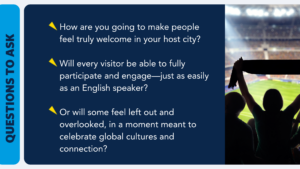
Because for millions of international fans, the experience won’t be defined by the match itself, it will be shaped by the moments in between.
So as cities prepare, there are a few critical questions to ask:
- How are you going to make people feel truly welcome in your host city?
- Will every visitor be able to fully participate and engage—just as easily as an English speaker?
- Or will some feel left out and overlooked, in a moment meant to celebrate global cultures and connection?
 English (US)
  English (Canada)
  English (Europe)
  English (UK)
  Español
  Français
  Deutsch
  Italiano