Language Access Is Critical Infrastructure for FIFA World Cup 2026
Why host cities are treating multilingual communication like transportation, security, and emergency response systems
As FIFA World Cup 2026 planning accelerates, host cities are moving from vision to execution. Funding is being allocated. Operational plans are being finalized. And one thing is becoming clear:
This is no longer about whether cities need multilingual communication, it’s about whether it will hold under pressure.
Not only are host city leaders asking, “How will we communicate with international visitors?”
They’re asking:
- What will break at scale?
- What can we deploy quickly across teams?
- How do we avoid bottlenecks e.g. interpreters, staffing, cost?
- What solutions are compliant and safe for public use?
The cities getting ahead of these questions are treating language access the same way they treat transportation systems, security operations and emergency response: as critical infrastructure.
Because at World Cup scale, traditional communication models fail:
- Human interpreters don’t scale across thousands of simultaneous interactions
- Phone-based language lines introduce delays in urgent moments
- Staffing consistency breaks down across venues, agencies and shifts
So the real question becomes: How do you operationalize communication so it works everywhere, instantly and reliably?
Can this scale across every touchpoint in our city?
FIFA isn’t a single venue: it’s an entire citywide (and statewide) ecosystem.
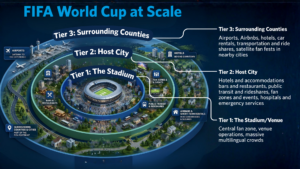
It starts at the airport, where international travelers arrive needing directions, transportation and support. It extends to rideshares, public transit, hotel check-ins and increasingly to Airbnbs and short-term rentals spread across outer neighborhoods and suburbs.
Host cities are intentionally decentralizing the experience:
- Instead of one central fan zone, many are creating “city ring” models, activating multiple neighborhoods, suburbs and even nearby cities
- In Seattle, official fan zones are planned across the state including Bellingham, Spokane, Tacoma, and Vancouver, turning the entire region into a FIFA experience
- The San Francisco Bay Area is preparing for distributed festivals across San Francisco, Oakland and San Jose
- In Kansas City, initiatives like ConnectKC26 are designed to move fans between decentralized events and the main stadium
At the same time, some cities are scaling back large, centralized watch parties shifting toward more distributed, community-based activations to manage cost, safety and logistics.
The result: there is no single “center” of the World Cup experience. Which means communication can’t be centralized either.
Pocketalk is built for exactly that reality:
- Works in noisy environments like stadiums, streets, and transit systems
- Designed for mobility like frontline staff on the move – no wifi connection required
- Supports urgent, unscripted interactions where clarity matters immediately
Can we deploy this quickly across teams with minimal training?
FIFA timelines are compressed. Teams are cross-functional. And many frontline workers are temporary, seasonal or reassigned.
That creates a major operational risk: If a solution requires training, scheduling or technical onboarding, it won’t be used when it matters most.
Host cities are prioritizing solutions that are:
- Instantly deployable
- Intuitive for any user
- Independent of specialized personnel
Pocketalk’s technology suite—powered by Prism Language Systems—is designed to meet teams where they are:
- A dedicated handheld device for frontline workers who can’t or prefer not to use personal mobile phones
- An enterprise mobile app that can be deployed instantly across existing work devices
- Sentio, a one-to-many solution for multilingual announcements and presentations
- Ventana, a centralized platform to manage devices, users and translation activity across teams
While the ecosystem is robust, the onboarding and user experience is intentionally simple.
Devices and apps work immediately with little to no training. In most cases, a five-minute walkthrough is all it takes for a user to confidently access real-time translation across more than 90 languages with no technical expertise required.
Is this cost-effective at FIFA-level demand?
Traditional translation models don’t just introduce expense, they introduce friction in the moments that matter most:
- Per-minute interpreter costs
- Delays tied to call-in translation lines
- Human interpreters availability and ability to be present in the moments that matter
- Hard-to-find translation resources for less commonly supported languages such as Swahili or Croatian
And that friction shows up on the frontlines. It forces staff to pause and ask: “Is this situation worth the cost of translating?” And your frontline teams should never have to decide if communication is “worth it.”
At an event like the FIFA World Cup, that hesitation is a risk because miscommunication doesn’t just slow things down, it can escalate situations, create confusion or prevent simple issues from being resolved quickly. Read our blog post about that here.
Host cities are shifting toward models that remove that friction entirely and Pocketalk’s model meets this moment with:
- Upfront investment instead of per-use or per-minute fees
- Unlimited usage so teams don’t have to decide if a conversation is “worth the cost”
- No dependency on human availability – 92+ languages are instantly accessible
- Mobile data included so connectivity isn’t an issue
- BONUS: Pocketalk translation technology can be used in government or public safety options after World Cup without an additional investment
At FIFA scale, the most cost-effective solution is the one that actually gets used—every time.
Can we trust it in high-stakes situations?
As FIFA host cities are evaluating solutions, decision makers are asking themselves, “can I trust this in a high-stakes situation?”
When it comes to translations technology, these are the top considerations from the product perspective:
- Can we trust the translation to be accurate?
- Can we trust the platform to protect data and meet security standards?
- Can we manage it centrally across departments?
But ultimately, it leads to a deeper, more operational question: can we trust our frontline teams to make real-time, on-the-ground decisions?
This is where enterprise-grade infrastructure matters. Pocketalk’s ecosystem supports this through:
- Ventana, a centralized management platform for device control, usage visibility, and security
- A privacy-first approach designed for sectors like healthcare, education and government
- Reliable, real-time translation powered by advanced AI models with Prism Language Systems
This isn’t theoretical, Pocketalk is already deployed at scale. Cities like Santa Clara have deployed Pocketalk to support multilingual communication during major global events like the Super Bowl, while statewide rollouts in Michigan demonstrate how agencies can scale access cost-effectively across large, distributed teams. In elections, jurisdictions like Cook County and Denver are treating language access as event infrastructure, using Pocketalk to support high-volume, time-sensitive voter interactions. And for large-scale gatherings, Pocketalk’s Sentio platform has delivered real-time, one-to-many translation across thousands of attendees, powering events like TCEA in the U.S., global health convenings with the World Health Organization in Thailand, and healthcare conferences in France—supporting dozens of languages and hundreds of hours of translation at a fraction of traditional costs.
The takeaway: this is more than a solution that works on paper—it’s one that’s already proven in the exact environments FIFA host cities are preparing for.
Closing: Communication is either infrastructure or a risk
The cities that succeed in 2026 won’t be the ones that planned for communication.
They’ll be the ones that built it into their infrastructure.
So the question is:
- Are you building communication into your infrastructure—or treating it as an afterthought?
- Can every visitor navigate your city with confidence, regardless of language?
- When pressure hits, will your teams respond instantly—or wait for support?
FIFA World Cup 2026 is a global moment. Make sure your city is ready to communicate like one.
 English (US)
  English (Canada)
  English (Europe)
  English (UK)
  Español
  Français
  Deutsch
  Italiano