Breaking the Language Barrier in Germany’s Pediatric Wards
KiO (Kinderhilfe Organtransplantation e.V. – German Pediatric Organ Transplant Support Association) – Chair, Franziska Liebhardt
~ Connecting hearts at the moments when words matter most.
How Pocketalk eases anxiety on pediatric wards, bringing peace of mind to families and medical staff ~
Editor’s note: This interview was conducted live across German and English through Sentio, Pocketalk’s AI interpretation platform.
■ Background
When a child is critically ill and their parents cannot understand a word the doctors are saying, fear compounds fear. That is the reality of many of Germany’s pediatric wards, which admit large numbers of refugee and immigrant families who do not speak German fluently. Parents already coping with a sick child face intense emotional stress, and when they cannot understand a doctor’s explanation, even simple everyday questions become a source of deep anxiety. To address this challenge, the pediatric organ transplant support organization KiO adopted total 45 Pocketalk translation devices and began donating these devices to hospitals. We spoke with KiO’s chair and Rio de Janeiro Paralympics gold medalist Franziska Liebhardt about the background to the implementation and its dramatic impact on the front lines.
■ Full Story
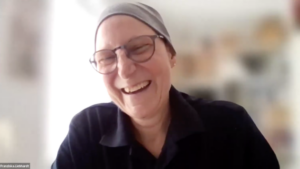
Franziska Liebhardt speaks with visible delight about the changes since implementing Pocketalk.
Q. Please tell us about KiO’s activities and the challenges you faced in medical settings before implementing Pocketalk.
A. We are KiO (Kinderhilfe Organtransplantation e.V.), an organization that supports children who have experienced organ disease or transplantation, and their families, working in partnership with pediatric hospitals and social services. Germany’s pediatric hospitals admit many families with immigrant or refugee backgrounds who do not speak German fluently. These parents already carry intense emotional stress and deep anxiety over their child’s health. Hospitals repeatedly told us that when families couldn’t understand a doctor’s explanation, even simple everyday questions became a major barrier. So we began looking for a quick, easy solution to smooth communication between medical staff and families.
Q. How did you handle communication before implementing Pocketalk, and what limitations did you face?
A. In the past, the hospitals relied on smartphone translation apps, but that meant staff had to use their personal phones, which raised data-privacy concerns and wasn’t always practical for immediate use on the spot. The hospitals also arranged professional interpreters, but calling one in for an urgent situation or a brief everyday conversation was extremely difficult. Complex medical explanations still require a professional interpreter, but for everyday conversation the hospitals needed a straightforward solution: a dedicated device that didn’t rely on staff’s personal phones and was always on hand in the ward, ready to use the moment it was switched on. We first learned about Pocketalk through our own research and a recommendation from another German NPO, Kleine Herzen Hannover.
Q. How did you assess the cost performance of Pocketalk?
A. In addition to its translation performance, what made Pocketalk so appealing was its flat-rate pricing plan – a fixed fee per unit covering five years, with Wi-Fi and mobile data all included, which we found very reasonable and easy to consider. For an organization like ours that runs on donations, having no hidden costs and a fully predictable budget is very important. Since German hospitals operate under tight budget constraints, being able to implement the devices at zero additional cost to the hospital was the deciding factor.
Q. How widely are the Pocketalk devices currently being deployed?
A. We started with just three test units at one hospital. The response from the frontline staff was so positive that we quickly ordered 30 more, and after receiving requests from other hospitals as well, we ultimately expanded to 45 units in total. These devices are now used across pediatric wards and pediatric dialysis centers by every kind of medical staff who interact with patients and families – doctors, nurses, social workers, and psychologists alike.
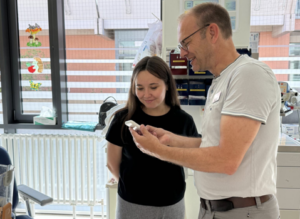
Q. Which languages are used most, and how is the device operated in these care scenarios?
A. Arabic is the most common language among refugee families. A wide variety of other languages are used as well. Pocketalk has covered every language needed at the hospitals. It’s also very intuitive to operate – even parents who were initially skeptical of the technology quickly pick up how to use it. Simply speaking into the device produces an instant translation shown as text on screen and spoken aloud, so both sides can communicate with confidence.
Q. Is there any memorable episode you could share where you felt that Pocketalk made a really significant difference in patient care?
A. It proves invaluable in daily ward routines – explaining test schedules, mealtimes, medication instructions, visiting hours, and more. But it’s the hospitals that feel its impact most powerfully, the moment a family first arrives on the ward. Parents who don’t speak German often arrive gripped by the fear that they won’t be able to communicate at all, but the instant they see that a conversation is possible with Pocketalk, you can watch that anxiety melt away.
Q. Ms. Liebhardt, you are a Rio Paralympics gold medalist and an organ transplant recipient yourself. Could you tell us about your journey and what drives you?
A. I won the gold medal in shot put at the 2016 Rio Paralympics. I have undergone lung and kidney transplants myself (three operations in total), and because I feel such profound gratitude for having my life saved, my work with KiO has become what I call my “Herzensangelegenheit” – a matter close to my heart. I use the voice I’ve gained as a former athlete to raise awareness about organ donation, a topic that still receives little attention in Germany, and to support families fighting illness with everything I have.
Q. Finally, do you have a message for medical institutions and organizations considering implementing Pocketalk?
A. I would strongly recommend Pocketalk to any organization that regularly interacts with people who speak different languages. It’s not a full replacement for the professional interpreters needed for complex medical explanations, but it removes the everyday “language barrier” and creates an opening for genuine human connection. For families facing difficult circumstances, that instant connection can be an enormous source of comfort – I’ve seen it firsthand.
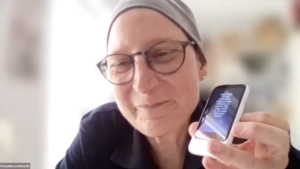
She demonstrated on the spot, using Pocketalk to translate a greeting from German into English.
■ Bring That Moment to Your Organization
KiO’s story shows what happens when a language barrier disappears at exactly the moment it matters most: fear gives way to trust, and care can begin right away. Whether you run a hospital, a school, or any organization that serves people across languages, Pocketalk can help you create that same moment of connection.
Contact us to find out what Pocketalk can do for you → Kontaktiere uns
 English (US)
  English (Canada)
  English (Europe)
  English (UK)
  Español
  Français
  Deutsch
  Italiano