AI Can Move Fast. Security Still Has to Come First.
The 2026 Stanford Human-Centered AI Index reported that the U.S. had 1,953 newly funded AI companies in 2025. That’s nearly 5 new funded AI companies every day, most built around launching AI products or services.
AI is not only accelerating development and go-to-market timelines, it’s also become the new marketing buzz word, to the point that it’s already causing consumer fatigue (e.g. do I really need an AI toothbrush) and skepticism.
In a market where AI is being added to everything—from email drafts to refrigerators—it’s easy to get caught up in the AI gold rush. At Pocketalk, we’re taking a different approach.
We’re not rushing features to market simply because AI is trending. We’re evaluating every advancement through the lens of security, privacy, compliance, and real customer value.
For Pocketalk, Security Comes First—Not Flashy Features
At Pocketalk, security and data privacy are the foundation of our technology.
When it comes to AI, security and data privacy remain some of the top concerns for consumers and enterprise leaders.
- 71% of consumers worry about AI data privacy and security — 2025 Consumer AI Survey, Menlo Venture
- 64.2% of enterprise leaders say data privacy and security are the #1 barrier to AI adoption — Enterprise AI in 2025 Survey, Burwood Group
Before introducing new AI capabilities, we start with one question: Will this make enterprise translation more secure or introduce new risk?
Because our customers operate in high-stakes environments—schools, hospitals, government agencies, detention facilities, and other frontline operations—we have a different standard. We’d rather invest in security, privacy, and reliability than launch flashy AI features that create buzz but add little real value to the people who depend on our technology.
That’s why our product roadmap is guided by enterprise security principles, including:
- Secure handling of sensitive conversations
- Clear governance over how data is stored and processed
- Transparency around what data is—and is not—used for model improvement
- Alignment with enterprise compliance expectations
AI Voice Cloning
We could build it. We chose not to.
What is it: AI voice cloning uses artificial intelligence to replicate the sound, tone, and cadence of a person’s voice, creating a more human-sounding translation experience.
Why it matters: In our industry, voice isn’t just a feature—it’s trust. While some translation device companies showcased voice cloning at CES, we saw the risk, not the headline. Voice cloning moves beyond translation into digital identity replication. Organizations including the FBI have warned about rising fraud schemes using AI-generated voices to impersonate executives, employees, and family members.
Why it matters to us: At Pocketalk, we knew we could offer this feature, but made a deliberate choice not to pursue it. Even if the feature wouldn’t directly expose customer data, the potential for misuse didn’t align with our security-first approach.
We’d rather pass on a flashy AI demo than compromise the trust our customers place in our technology. Read more about our thought process here.
How Pocketalk Uses AI and How We Don’t
AI absolutely has a role in the future of language technology, but only when it solves a real customer need. At Pocketalk, we’re using AI where it enhances communication, including:
- Improving translation accuracy
- Better speech recognition across accents and noisy environments
- Reducing background noise and improving clarity
For example: Pocketalk uses AI to smooth translations by removing filler words, pauses, and verbal clutter—like “um,” “ah,” or repeated phrases—creating a more natural experience in both voice and on-screen text.
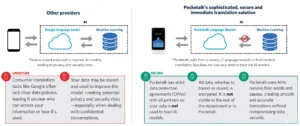
How We Protect Security and Privacy
Just as important as how we use AI is how we protect customer data. Unlike consumer translation apps that may store conversations or use customer data to improve models, Pocketalk is built with enterprise security at its core.
- Translations are not stored by default
- Customer conversations are not used to train AI models
- Users can clear translation history at any time
- Communications are protected with encryption, with no personal accounts required
For organizations managing devices at scale, Pocketalk’s Ventana platform adds another layer of control—allowing administrators to manage settings, remotely lock lost devices, and monitor usage securely.
Questions to Ask When Evaluating Enterprise Translation Technology
Not all translation solutions are built for enterprise environments. If your organization handles sensitive conversations, regulated information, or frontline communication, security and privacy should be part of the evaluation—not an afterthought.
Here are a few important questions to ask:
Privacy & Data Security
- Are translations stored on the device or in the cloud?
- Is conversation history automatically deleted, or does it remain accessible after use?
- Can users hide, clear, or permanently delete past translations?
- Are translations encrypted during transmission?
- Does the solution require users to create personal accounts or share personal information?
- Is customer data used for analytics, product improvement, or AI model training?
Device & User Controls
- Can users control whether previous translations remain visible on screen?
- Does the device support privacy features like screen locks, PIN protection, or session timeouts?
- Can organizations disable certain features for added security?
- Are administrators able to remotely lock or manage lost devices?
Enterprise Administration
- Can IT teams centrally manage devices, settings, and user permissions?
- Are usage insights available without exposing sensitive conversation data?
- Is there a remote management platform for device oversight and compliance?
Compliance & Vendor Trust
- Has the solution been independently reviewed for security and privacy standards?
- Does the provider align with enterprise compliance expectations, such as HIPAA, FERPA, or GDPR?
- Does the vendor clearly explain what happens to your translation data—and what doesn’t?
The right translation technology shouldn’t just translate accurately. It should protect your people, your conversations, and your organization.
For a deeper dive, download our white paper: Selecting the Best Translation Solution for Your Communication Needs: A practical guide for organizations seeking secure, accurate, and scalable translation technology.
In Closing: Innovation With Guardrails
AI will continue to evolve and so will we. We’re actively evaluating new technologies, new models, and new ways to improve multilingual communication.
But one thing won’t change: At Pocketalk, innovation only moves forward when security moves with it.
Because in enterprise communication, trust isn’t optional. It’s infrastructure.
 English (US)
  English (Canada)
  English (Europe)
  English (UK)
  Español
  Français
  Deutsch
  Italiano